Ensure the reliability of your measuring instruments and gas analysis systems with an industrial maintenance contract tailored to your facilities.
Fuji Electric supports manufacturers by offering preventive maintenance, calibration, inspection, and repair services for their measurement equipment. Our services cover pressure sensors and transmitters, flow meters, level and temperature instruments, as well as gas analysers , and continuous emissions monitoring systems (CEMS).
Our expert technicians provide on-site service in France and throughout Europe to perform the maintenance required to ensure your equipment operates properly.
Our goal is to help you maintain the accuracy of your measurements, anticipate failures, control your maintenance costs, and extend the service life of your equipment.
Each contract is tailored to your equipment, its criticality, your operational constraints, and your technical support needs.
An industrial maintenance contract is an agreement between a service provider and a company that specifies the equipment covered, the maintenance and inspection procedures, their frequency, the responsibilities of each party, and the terms of service.
It helps structure a process for failure prevention and preventive maintenance to:
Scheduled maintenance allows organizations to shift from a “repair after failure” approach to a proactive strategy based on the condition and criticality of equipment.
In every industrial sector, measuring instruments play a central role in monitoring, controlling, and regulating industrial processes.
An incorrect measurement can lead to improper process control, a decline in quality, excessive energy consumption, a false alarm, or, in some situations, a production shutdown.
Maintenance and instrumentation managers must ensure the availability of their equipment while managing their technical resources and budgets.
Industrial sensors and e analysers s are subject to mechanical, thermal, chemical, and environmental stresses that can gradually affect their performance.
A measurement problem can result from wear and tear on an electronic component, a diaphragm, a connection, a leak, contamination, or an incorrect configuration.
Regular inspections help detect certain abnormalities before they cause a breakdown or significant deterioration in the process.
An instrument's accuracy may change due to aging, operating conditions, or repeated use.
Verification and calibration procedures help identify measurement discrepancies and determine whether the instrument remains suitable for its intended use.
Reliable measurements are essential for properly controlling a process, maintaining product quality, and making sound operational decisions.
Emergency repairs, unexpected repairs, travel expenses, and equipment downtime can result in significant costs.
A contract makes it possible to organize service calls, anticipate the need for supplies, and plan operations that require the facility to be shut down or made available.
A structured preventive maintenance program makes it easier to forecast expenses and reduces reliance on unplanned corrective actions.
Manufacturers sometimes operate equipment that has been in place for many years, the maintenance of which requires specialized knowledge.
Technological advancements, staff turnover, and the obsolescence of certain components can complicate maintenance work.
Hiring a professional who specializes in industrial instrumentation provides access to additional expertise for diagnosing, repairing, inspecting, or replacing equipment.
Companies are sometimes required to demonstrate proficiency in the use of their instruments as part of their quality systems, internal procedures, or regulatory requirements.
Maintenance reports, calibration certificates, and inspection reports are useful tools for traceability.
A maintenance contract makes it easier to organize and document inspections, without replacing the operator’s regulatory responsibilities.
Industrial measuring instruments continuously monitor the parameters essential to the operation of facilities.
Fuji Electric offers maintenance, calibration, inspection, and repair services tailored to the measurement technologies and specific requirements of each application.
These services can be provided as one-time services or as part of periodic maintenance contracts, based on a program tailored to the management of instrument fleets.
Maintenance requirements vary depending on the measurement principle, operating conditions, and the criticality of the equipment.
| Industrial Instruments | Main Possible Operations |
|---|---|
| Pressure Sensors and Transmitters | Inspection, zero check, range check, calibration, and diagnostics; connection checks, pulse lines, configuration, and measurement |
| Industrial Flow Meters | Verification of operation, settings, output signal, and measurement consistency |
| Level measurement instruments | Verification of configuration, assembly, connections, and measurement response |
| Temperature Probes and Transmitters | Verification of the measurement chain, wiring, and metrological performance |
| HART-Enabled Instruments | Reading diagnostics, verifying settings, and checking communications |
The exact scope of services depends on the equipment specifications, the available testing resources, and the conditions under which the work is performed.
An industrial facility may include several dozen or hundreds of measuring instruments distributed across various processes.
Their technological diversity, age, and operating conditions make maintenance management more complex.
A periodic maintenance program makes it possible to organize the monitoring of installed equipment, prioritize maintenance tasks based on the criticality of the instruments, and identify the specific maintenance needs of each production unit.
The first step is to have a thorough understanding of the equipment in question.
An inventory may include, among other things, part numbers, serial numbers, technologies, locations, measurement ranges, verification dates, and service histories.
Not all instruments present the same operational challenges.
A transmitter used for a secondary display does not necessarily require the same level of monitoring as an instrument that is essential for controlling a critical stage of production.
The analysis may take into account the impact of a failure on safety, quality, system availability, and operating costs.
The maintenance program specifies the tasks to be performed, their frequency, the necessary resources, and the conditions for accessing the equipment.
It can be adapted to production downtime, the workload of maintenance crews, and operational constraints.
The history of calibrations, repairs, and maintenance allows us to identify instruments with recurring defects or abnormal drifts.
This information helps adjust maintenance schedules and plan for replacements.
As equipment ages, technology evolves, and the availability of parts changes, certain repairs may become difficult or economically unfeasible.
Asset tracking makes it possible to identify equipment that needs to be monitored and, when necessary, to plan for its replacement.
Instrument lifecycle management aims to ensure their availability and reliability while controlling resources and maintenance costs.
Even with a preventive maintenance program, some instruments may malfunction and require corrective action.
Fuji Electric offers diagnostic and repair services for its industrial measuring instruments.
Depending on the nature of the defect, the type of instrument, and the technical resources required, repairs can be performed on-site or in the workshop.
These operations may include identifying the malfunction, replacing components, performing repairs, and conducting the necessary checks before the equipment is put back into service.
A technical assessment helps determine whether repair is appropriate or whether replacing the instrument is a better option.
The contract must be selected based on the equipment involved, the criticality of the measurements, and operational constraints.
| Service | Frequency or Principle | Objective |
|---|---|---|
| Maintenance of Measuring Instruments | As specified in the contract | Instrument Reliability and Monitoring |
| Calibration and Verification | According to a defined frequency | Metrological Control |
| Instrument repair | As needed | Restoration of Operations |
Services are defined based on the scope of the installation and the agreed-upon terms.
The maintenance contract serves several operational objectives.
| Objective | Indicator |
|---|---|
| Reduce Failures | Number of breakdowns and incidents |
| Improve availability | Equipment Downtime Duration |
| Ensuring Measurement Quality | Audit Findings and Identified Deviations |
| Follow the maintenance schedule | Rate of completion of scheduled visits |
| Improving Traceability | Availability of Reports and Certificates |
| Controlling Expenses | Annual Cost of Maintenance and Repairs |
| Planning for Replacements | Number of devices at risk of becoming obsolete |
These indicators can help the operator assess the effectiveness of its program.
The results depend on the initial condition of the fleet, operating conditions, the resources allocated, and the scope of the study.

This agreement defines the equipment covered, maintenance procedures, the frequency of service calls, and the terms of service. It enables the organization of preventive maintenance and, depending on the plan, corrective services. A performance-based contract sets specific, quantifiable objectives for the service provider.
Preventive maintenance includes procedures designed to reduce the likelihood of failure or deterioration. Preventive maintenance reduces breakdowns by 30 to 50 percent.
Corrective maintenance is performed after a breakdown or malfunction has been detected.
A contract can be considered for pressure transmitters, flow meters, level instruments, temperature equipment, and gas analysis systems.
The scope depends on technical capabilities and service conditions.
The industrial facility assessment includes an inventory and evaluation of equipment criticality.
Yes, Fuji Electric offers periodic maintenance services for instrument fleet management. Inspections and procedures are determined based on the model numbers, the condition of the devices, and the criticality of the measurements.
The frequency depends on the environment, the product's history, the manufacturer's recommendations, and quality requirements.
A technical analysis helps determine an appropriate inspection schedule. Regular inspections can reduce breakdowns by 18%.
Calibration determines the relationship between an instrument's readings and reference values.
Maintenance includes operations intended to maintain or restore proper functioning.
The two services complement each other.
The scope is defined in the contract. Some parts or consumables may be included, while other replacements may require an additional quote.
The price depends on the type of instruments, the number of pieces of equipment, the procedures required, and the conditions of the procedure.
The main criteria include:
A customized quote allows us to develop a maintenance plan tailored to the technical needs and budget of your facility.
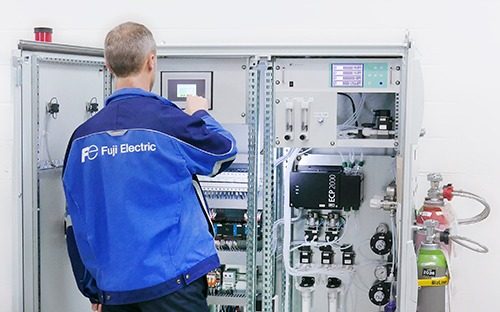
Continuous air emissions monitoring systems (CEMS) are used to measure the concentrations of gases emitted by industrial facilities, including boilers, combustion units, and industrial heating equipment.
Preventive maintenance of CEMS systems helps ensure the reliability of measurements, minimize the risk of failure, and maintain the availability of gas- analysers . It covers the entire measurement chain: sampling probes, gas transport and conditioning systems, analysers , and data acquisition systems.
For facilities subject to regulatory emissions monitoring, regular maintenance helps ensure the quality of the data used for environmental monitoring, QAL2 and AST procedures, and GEREP reports, where these requirements apply.
Drawing on its expertise inthe design of gas analysis systems andanalysers cabinets, Fuji Electric offers CEMS maintenance contracts tailored to the equipment, its frequency of use, and the operational constraints of each facility.
Fuji Electric offers several preventive maintenance plans for continuous emissions monitoring systems (CEMS). These plans are tailored to the needs of industrial facilities, particularly boilers and combustion systems.
Choose the maintenance schedule that best suits your system: every six months, every three months, or every month.
Our technicians perform maintenance on gas- analysers , inspect sampling lines, check equipment, and replace the consumables specified in the contract.
| Service | Frequency or Principle | Objective |
|---|---|---|
| CEMS P2C Maintenance | 2 in-depth visits per year | Semiannual Preventive Maintenance |
| CEMS P2TC Maintenance | 4 in-depth visits per year | Quarterly Preventive Maintenance |
| CEMS P2MC Maintenance | 12 visits per year, including 2 in-depth visits | Monthly Monitoring and Maintenance |
| CEMS P2D Troubleshooting | Up to 2 procedures per year | Roadside Assistance |
| QAL2/AST Support | According to the inspection schedule | Support for Regulatory Inspections |
| CEMS Remote Assistance | Up to 8 sessions per year | Remote Diagnostics and Support |
| UTC Synchronization | Annual Subscription | Reliability of Data Timestamping |
| CEMS Training | 4-hour on-site session | Autonomy of Operations Teams |
All of our service plans include technical follow-up and a report after each service call.
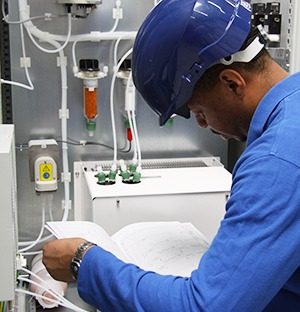
Fuji Electric offers three preventive maintenance plans and five additional services to ensure the reliability and availability of your continuous emissions monitoring systems (CEMS).
Our industrial maintenance contracts cover the maintenance of gas- analysers , technical inspections, the replacement of contractually specified consumables, and equipment monitoring. Options for troubleshooting, remote assistance, training, and support with regulatory inspections allow us to tailor our services to the needs of each facility.
The P2C contract includes two thorough preventive maintenance visits per year, performed on-site by our specialized technicians.
Depending on the configuration of your gas analysis system, each service call includes:
This plan is the basic preventive maintenance contract for our CEMS systems.
The P2TC contract includes four comprehensive preventive maintenance visits per year, or one visit each quarter.
Each visit includes the same technical services as the P2C semi-annual contract: inspection, cleaning, equipment checks, verification of the analysers , and replacement of the consumables specified in the contract.
This approach helps strengthen the monitoring of facilities subject to significant operational stresses or requiring more frequent maintenance.
The P2TC quarterly contract is a standalone plan that includes a total of four visits per year.
The P2MC contract includes twelve visits per year: two P2C thorough maintenance visits and ten interim visits.
In-depth visits cover all of the activities included in the semiannual plan.
The ten interim visits include, among others:
This package is particularly well-suited for CEMS systems that require monthly monitoring and regular performance tracking.
The P2D option supplements preventive maintenance with technical support in the event of a breakdown or malfunction of your gas analysis system.
It includes up to two on-site repair visits per year, with a technician arriving within a maximum of three business days after receipt of a complete written request.
Our technicians identify the cause of the issues and perform any possible corrective actions on site using standard tools. A report is provided after each service call.
The estimated time frame refers to the technician's arrival and does not guarantee that the problem will be resolved. Replacement parts, repair supplies, and any additional travel costs are not included.
Fuji Electric offers technical support services to assist regulatory agencies with the QAL2 and AST procedures applicable to automatic air emissions measurement systems.
This service includes one day of on-site support from a Fuji Electric technician when the QAL2 and AST inspections are scheduled for the same date.
A preventive maintenance visit specified in the contract is scheduled during the month prior to the tests in order to prepare the analysis system.
The procedure must be scheduled at least two months in advance.
The tests, baseline measurements, and certifications performed by the inspection agency are not included in this service.
Fuji Electric offers a remote support service that enables its technicians to provide remote assistance to operations and maintenance teams.
This annual plan includes the installation of a remote control module and up to eight remote support sessions per year, each lasting up to one hour.
Complete written requests are processed no later than the next business day after they are received.
The service is available Monday through Friday, excluding holidays, from 8 a.m. to 12 p.m. and from 2 p.m. to 5 p.m.
This service is available only to systems running version 7 of the software and also requires a subscription to the UTC synchronization service.
UTC synchronization ensures consistent timestamping of the data recorded by your air emissions monitoring system.
Fuji Electric offers an annual subscription that includes a SIM card and the associated UTC synchronization service.
This service is available only for systems running software version 7. It may be necessary to meet applicable regulatory requirements when the installation does not have another compliant solution recognized by Fuji Electric.
An upgrade of systems running an earlier version of the software can be considered separately.
Fuji Electric offers on-site technical training for industrial operations and maintenance teams.
This service includes a four-hour training session led by a specialized technician.
In particular, it covers:
This optional training session is held during the first preventive maintenance visit in the first year of the contract.
It is a one-time benefit that is not automatically renewed in subsequent years.
CEMS contracts are established for an initial term of 12 months, with the option of annual renewal up to a maximum of 36 months.
The terms and conditions for renewal and rate adjustments are set forth in the contract. Each offer is tailored to the selected equipment and services.
Maintenance also applies to accessories associated with analysers, including fittings, valves, pressure regulators, and sampling devices.
Equipment | Maintenance Operations |
|---|---|
Sampling Probe | Inspection, cleaning, and condition assessment of components |
Filters and Pre-filters | Inspection and replacement based on the degree of fouling |
Heated sampling line | Checking the temperature, condition, and seal |
Sampling pump | Checking Suction, Flow Rate, and Wear |
Gas cooler or dryer | Monitoring Cooling and Condensate Drainage |
Gas Circuits and Solenoid Valves | Checking for leaks, connections, and switches |
gas analysers | Cleaning, functional testing, metrological checks, and adjustments |
Analysis Cabinet | Checking the ventilation, air conditioning, and filters |
Data Acquisition System | Verification of Alarms, Communications, and Software Settings |
| Equipment | Consumables and Wear Parts |
|---|---|
| 1. Sampling probe | Ceramic filter, sintered stainless steel filter, filter cartridge, O-rings (Viton, FKM, PTFE), flat gaskets, seals, flange gaskets |
| 2. Backblow System | Solenoid valve seals, valve diaphragms, compressed air filter cartridges, pneumatic silencers |
| 3. Heated sampling line | PTFE/PFA inner tubes, connection seals, fittings and sealing rings, insulating sleeves |
| 4. Gas Conditioning Unit | Particulate filters, fine filters, coalescing filters, hydrophobic filters, filtration membranes, filter holder gaskets |
| 5. Refrigeration Unit | Heat exchanger gaskets, connection gaskets, heat exchanger (replacement part), downstream filter cartridges |
| 6. Gas sampling pump | Diaphragms, bellows, suction/discharge valves, gaskets, pump heads, repair kit, complete replacement pump |
| 7. Peristaltic condensate pump | Peristaltic tubes, rollers, hoses, drain hoses, complete replacement pump |
| 8. Condensate Management | Hydrophobic filters, condensate trap seals, drain pipes, liquid detector membranes |
| 9. Pneumatic circuit | PTFE/FEP/PFA tubing, fittings, seals, solenoid valve diaphragms, check valves, pneumatic filters |
| 10. Flow Measurement and Control | Flowmeter floats and tubes, rotameter seals, orifices, regulator seals, control diaphragms |
| 11. NOx converter (NO₂ to NO) | Catalytic converter, catalytic converter components, high-temperature gaskets, internal tubes |
| 12. NDIR/UV Gas Analyzer | Internal filters, measurement cell seals, windows and optical benches, cuvette seals, lamps or light sources depending on the technology, maintenance kit |
| 13. Oxygen Analyzer | Electrochemical cell, oxygen sensor, cell seals, protective filters, electrolyte (if applicable) |
| 14. Zirconia O₂ Analyzer | High-temperature gaskets, ceramic filters, protective components, zirconia cell (replacement part) |
| 15. Calibration System | Calibration gas cylinders, zero gas, purification cartridges, regulator seals, regulator diaphragms, fittings |
| 16. Analysis Cabinet | Ventilation filters, air conditioning filters, filter foam, air intake filters, fans, desiccant cartridges |
| 17. Cabinet Air Conditioning | Air filters, washable or replaceable filters, fans, door gaskets, condenser filters (depending on design) |
| 18. Additional gas treatment | Activated carbon, chemical absorbents, desiccant cartridges, silica gel, neutralization cartridges, drying membranes |
| 19. Dust Detection / Opacimeter | Purge air filters, filter cartridges, optical window seals, cleaning kits |
| 20. General Maintenance | Seal kits, fuses, flexible hoses, clamps, optical cleaning supplies, compatible sealants |
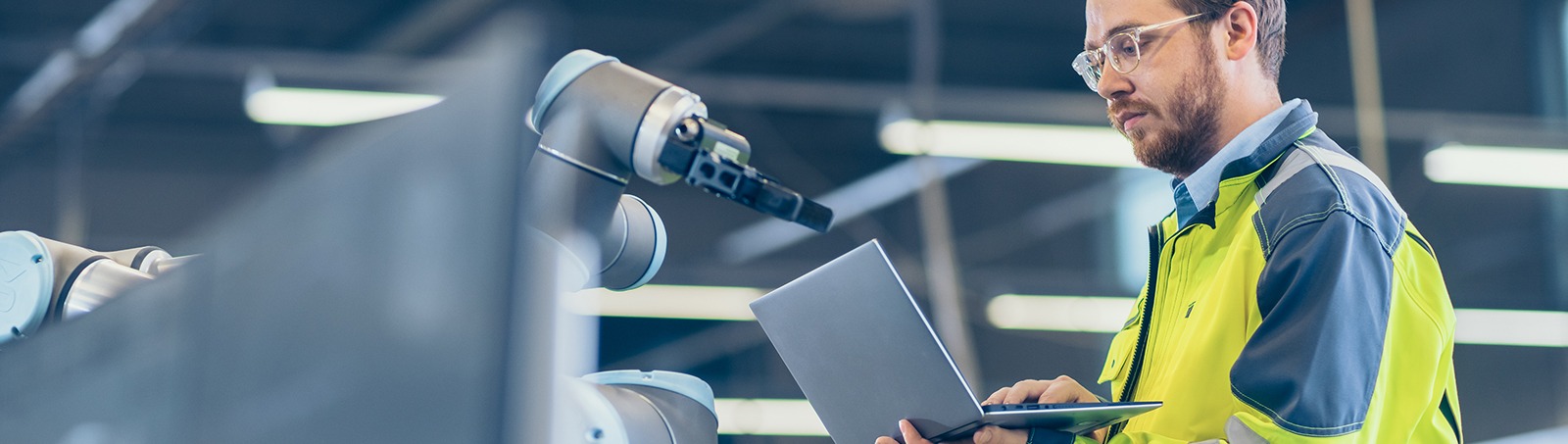
Fuji Electric has expertise in industrial measurement technologies and continuous emissions monitoring systems (CEMS)
This expertise enables us to assist manufacturers with the diagnosis, inspection, and maintenance of their equipment.
Maintenance can be combined with other Fuji Electric services, such as commissioning,calibration, repair, and technical support.
This complementary approach makes it easier to track equipment from the time it is installed through maintenance and replacement.
Interventions are planned taking into account site operations, process operating conditions, access to equipment, and safety requirements.
Fuji Electric's teams work with their industrial customers to develop solutions tailored to their equipment and operational constraints.
Our approach aims to anticipate failures, maintain measurement quality, and support initiatives to improve the long-term reliability of industrial equipment.
Proper maintenance is essential for gas- analysers s to operate accurately and efficiently over the long term. In this article, discover three best practices for maintaining your gas- analysers s.
March 15, 2023

GEREP 2027: Requirements, Measurement of Atmospheric Releases, Emissions Monitoring, and Regulatory Compliance for ICPEs.
June 11, 2026