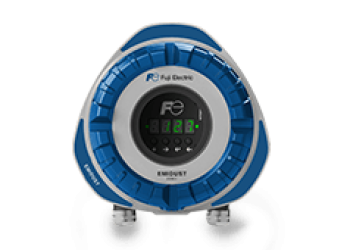
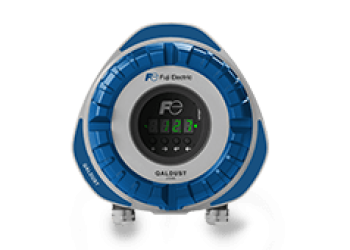
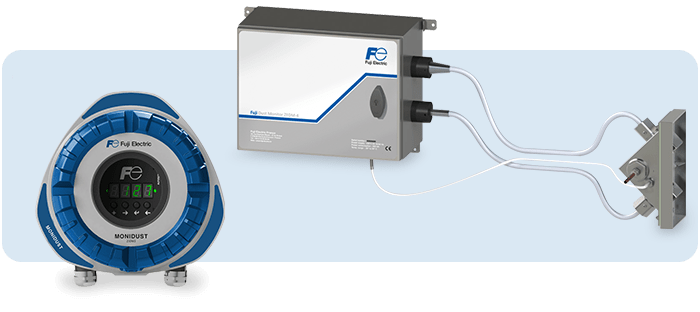
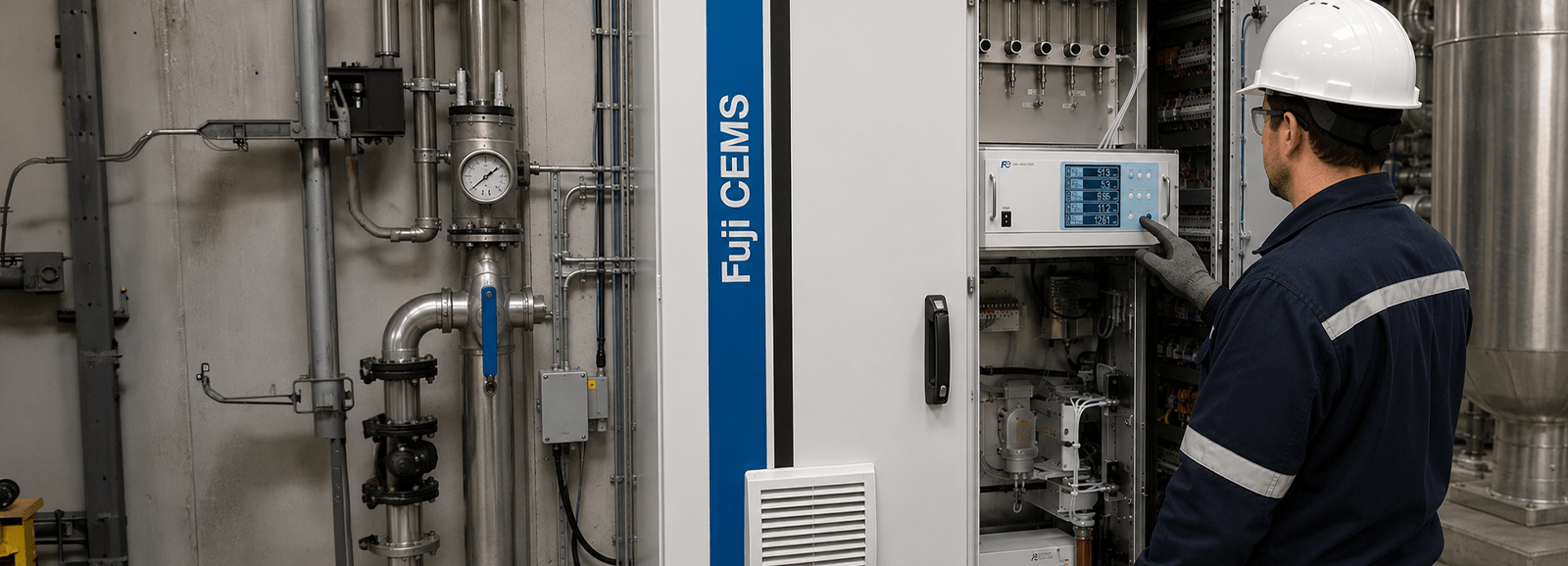
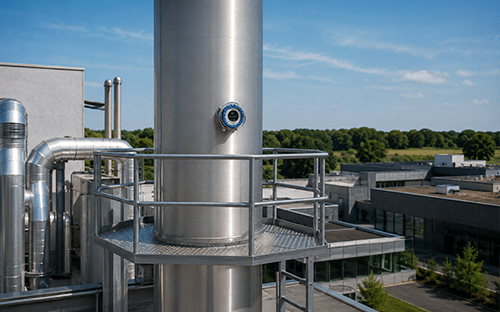
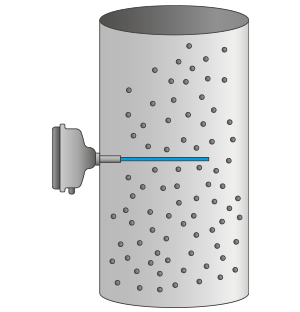
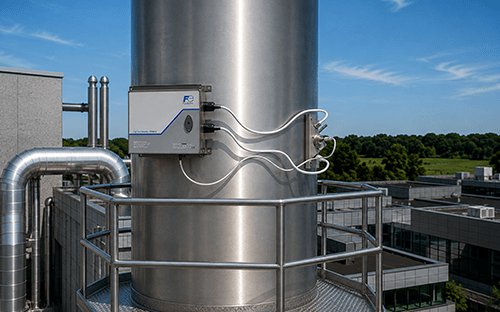
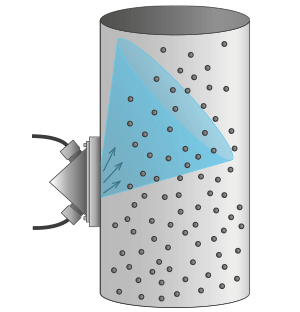
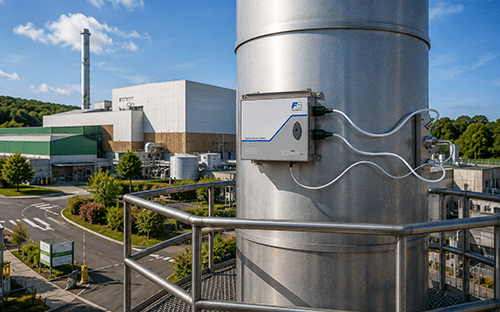
The dust monitor is used to continuously monitor the concentration of solid particles in process gases or atmospheric emissions. It is an essential piece of equipment...
Dustanalyser s provide continuous monitoring of the concentration of solid particles in process gases or atmospheric emissions. They are essential equipment for monitoring the performance of filtration systems, ensuring regulatory compliance, and protecting industrial facilities.Depending on the application, Fuji Electric dust analysers s use inductive ionization technology or LED optical backscatter technology to ensure reliable measurement in process ducts, industrial stacks, and CEMS systems. These technologies can be adapted to the characteristics of the flue gas, the dimensions of the ducts, and the metrological requirements of each facility.Thanks to their QAL1 certification, excellent sensitivity, and robust design, Fuji Electric’s solutions enable rapid detection of deviations in filtration systems, help limit particulate emissions, and optimize the environmental performance of industrial processes.
Find out how Fuji Electric is replacing its older gasanalysers models with innovative, sustainable versions that optimize performance and environmental compliance.
Dust monitor buying guide
Dust monitors are commonly used to identify and potentially quantify the presence of solid particles in a gas mixture. Several technologies exist for measuring particle concentration, and the choice depends on the application’ datasheet .
Brochure
Fuji Electric gas analysers
Download the brochure to find out more about precise, robust multi-gas analysis solutions for all your industrial applications.
How do you choose the ideal dust monitor technology for measuring particle levels?
Dust monitors, or dust analysers, are generally used to detect and, if necessary, quantify the presence of solid particles in a gas mixture.
There are 2 categories of functions:
The analysers , known as “ analysers -process” systems, which are used to control industrial processes
The analysers for monitoring dust emission levels, known as “dust CEMS” (for Continuous Emissions Monitoring System)
Depending on the application, manufacturers use the two most advanced technologies/methods:
A - Optical technology using light scattering
B - The inductive electrification method (most recent development of fundamental triboelectric technology)
The following table provides a general overview of the most suitable method and the ideal Fuji Electric dust monitor based on the required function:
Function / method
1 analyser process dust
2 analyser of dust emissions
A Light backscattering (LED optical technology)
-
ZFDM-4
B Inductive electrification (advanced triboelectric technology)
ZiDM-3 MONIDUST
ZiDM-5 QALDUST or ZiDM-4 EMIDUST
When it comes to emissions monitoring—that is, when a Continuous Emissions Monitoring System (CEMS) is required—both technologies are viable options. The choice will depend on the application’ datasheet . The following sections explain in more detail how to select the ideal dustanalyser based on the application.
Case 1: Process Dust analyser
A dust analyser ,or dust monitor, is used to detect the presence of solid particles or to quantify the concentration of solid particles in a gas stream.
A very common example is the detection of dust following the breakage of a bag filter. The dust detector will immediately inform the operator that a filter is damaged. The operator will save time, human and financial resources, and considerably limit the environmental impact of the event by reacting quickly, thus quickly recovering an operational industrial process.
Process dust analysers equipped with trend monitoring are used to measure the amount of solid particles in a gas stream.
Here are just a few examples:
Monitoring dust concentration downstream of a filter. When this dust concentration measurement starts to drift, the operator is informed. He knows that he can clean or replace the filter.
Monitoring the quantity of solid particles circulating in a pneumatic conveyor. For example, measuring the flow of grain in a sheath in the agricultural industry, or sugar crystals in the food industry.
For process applications, the ideal particle monitoring technology is the inductive electrification method.
This is the most advanced evolution of the famous "triboelectric" method. We explain the difference in the technical description of the ZiDM series.
Why choose a triboelectric (or inductive electrification) dust analyser for particle monitoring in an industrial process?
In many cases, solid particles flow through a small-diameter pipe. The inductive electrification dust analyser can be configured for small- and medium-diameter pipes.
Case 2: Dust monitor at the source
When a dust monitor is used to measure the concentration of solid particles emitted into the atmosphere as a result of a combustion process or any other industrial process, both technologies can be used.
What are the criteria for selecting a dust- analyser at the point of emission?
Thanks to their innovative design, Fuji Electric’s QAL1-certified dust analysers meet these five requirements using each of the two cutting-edge technologies:
When should you choose an inductively charged dust monitor for continuous emissions monitoring (CEMS)?
Manufacturers use dust monitors based on inductive electrification technology when the chimney has a small or medium diameter.
They will then use one or the other of the 2 technologies depending on the following parameters:
Flue gas temperature and velocity
Type, nature and diversity of particles
Filtration technology used before emission discharge
Is it possible to use a triboelectric dust monitor when the combustion plant is equipped with an electrostatic precipitator?
The answer is no... but...
No, because the response of a basic triboelectric dust monitor will be affected by the operation of the electrostatic precipitator.
But ... it's possible with inductive electrification technology.
So, ultimately, YES, the Fuji Electric ZiDM Series dust monitors, which use advanced inductive electrification technology, are used even when an electrostatic precipitator is installed in the system.
The only situation in which measurements may be affected is when the ZiDM Series dust and particle detector is located immediately downstream of the electrostatic precipitator. However, in most cases, flue gas treatment equipment and/or a sufficient distance exist between the electrostatic precipitator and the dustanalyser . For example:
NOx reduction system (usually DeNOx SCR - Selective Catalytic Reduction)
Desulfurization system
Fine particle filtration with bag filters
When should you choose a light scattering technology dust monitor for emission measurements (CEMS)?
We use light scattering technology dust monitors when:
The chimney diameter is medium or large
Flue gas velocity is high, low or even very low
An electrostatic precipitator is installed immediately upstream of the dust analyser
The flow rate is highly variable and cannot be measured.
In all other cases, the manufacturer is free to choose either technology.
If you have any questions, the experts and partners at Fuji Electric France will be happy to help you choose the best solution for your dust monitoring application.
Fuji Electric France's experts will be happy to help you choose the best solution for dust monitoring.
Sales department
The sales team is at your disposal to assist you with your projects.








 Dust monitor by inductive electrification
 Dust monitor by light scattering technology