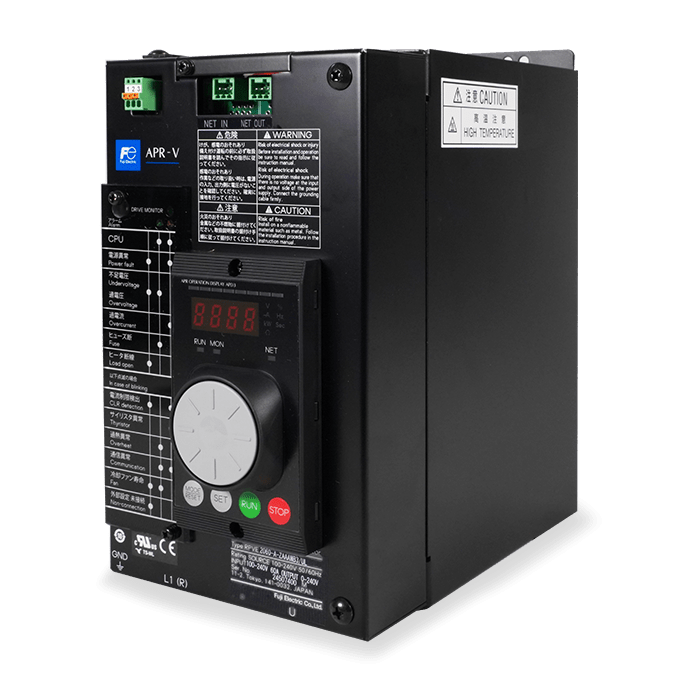
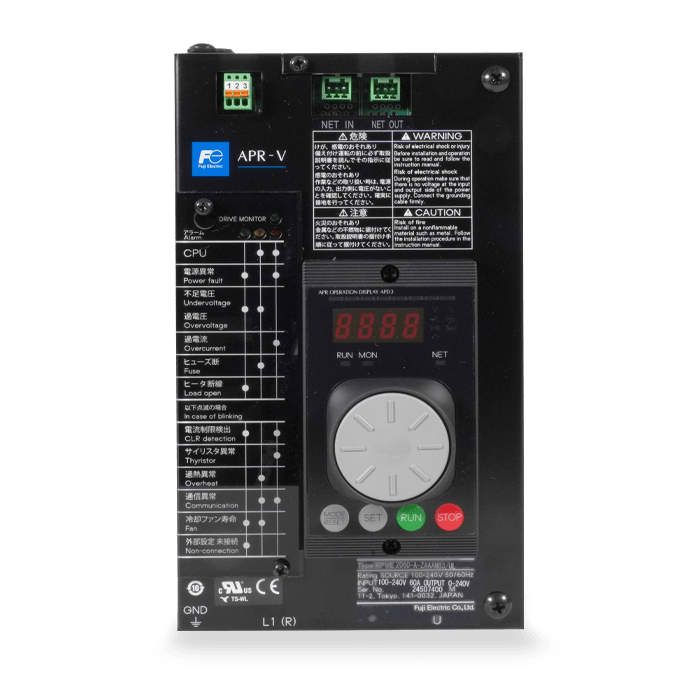
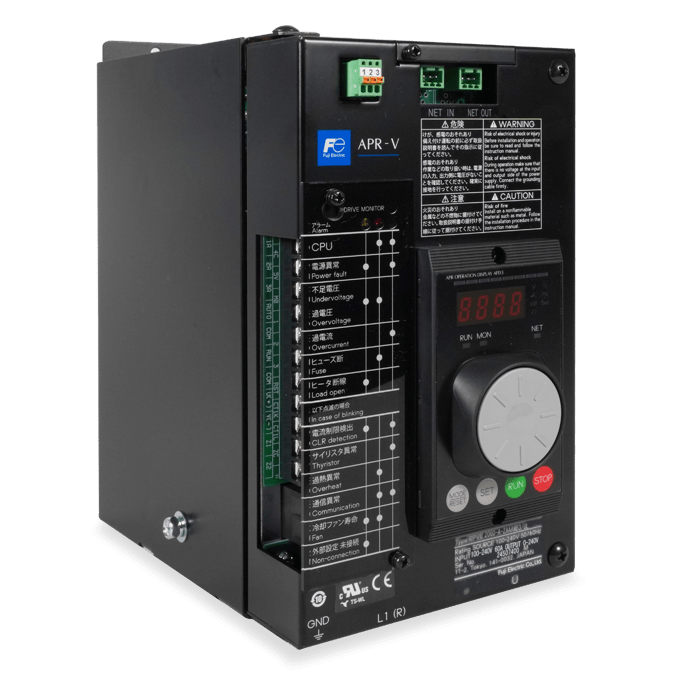
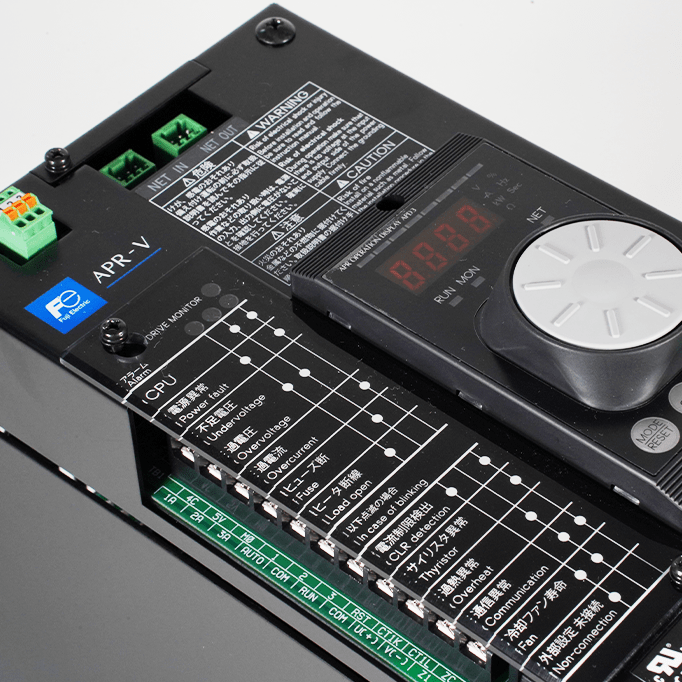
Three-phase power control
Fields of application
Control of three-phase electric furnaces, heating of industrial ovens and dryers, heat treatment equipment, and primary-side control of transformers or rectifiers, depending on the configuration.
Benefits
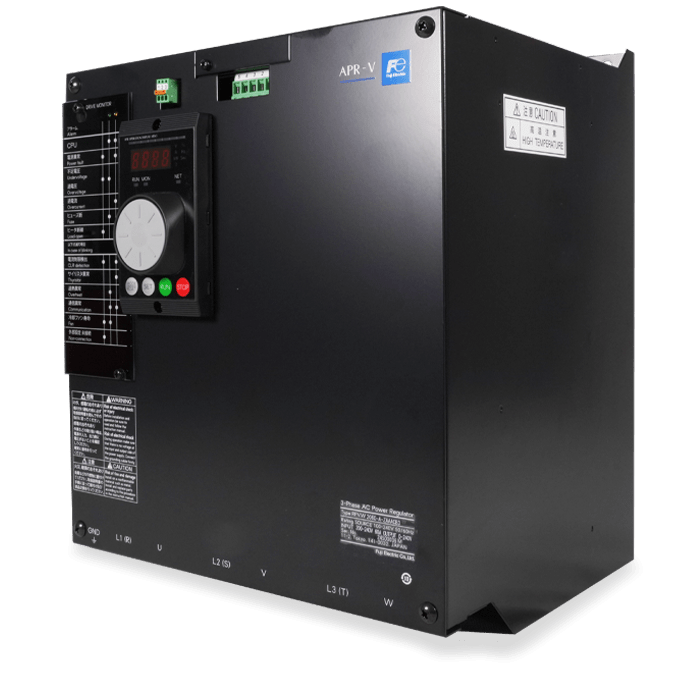
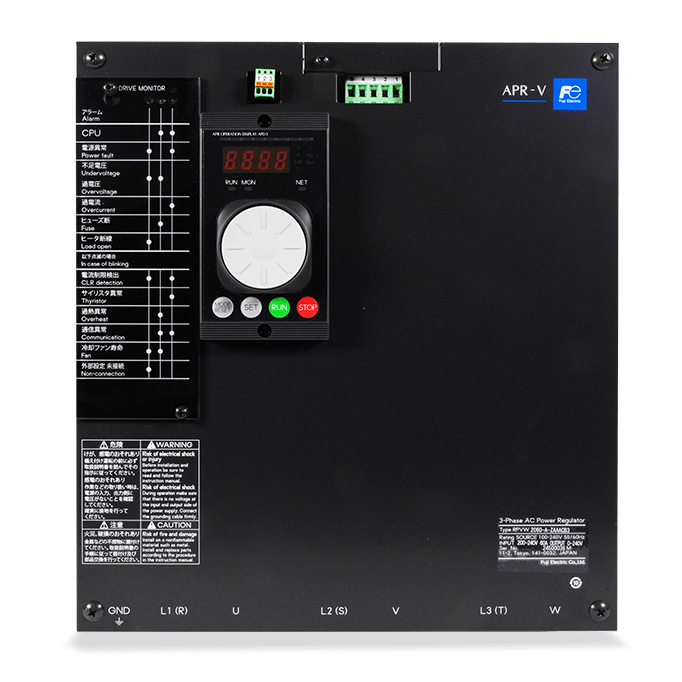
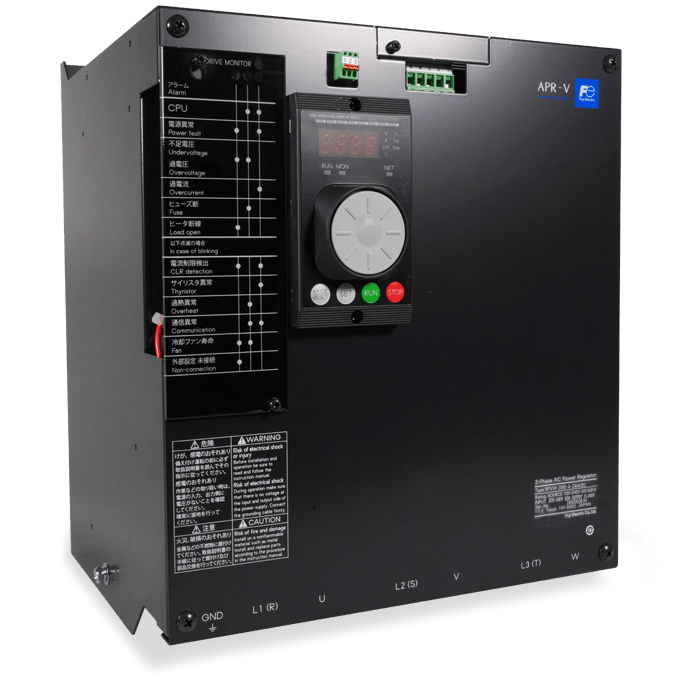
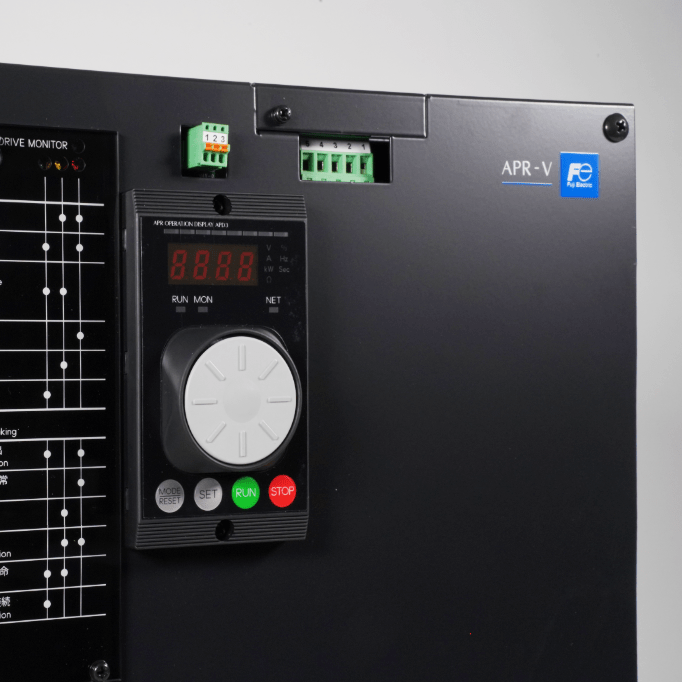
Fuji Electric’s APR-V three-phase power controller regulates three-phase-powered heating equipment and industrial loads. Its six-thyristor architecture allows it to control resistive or inductive loads depending on the selected configuration. Feedback functions adapt the control to the electrical variable being regulated, while ramps facilitate operational transitions. For automated systems, communication options facilitate data exchange with the PLC and the supervisory system. The three-phase APR-V succeeds the three-phase APR-N while maintaining installation and wiring compatibility.
| Rated current [A] (Ambient temperature 50 °C) | 20, 45, 60, 100, 150, 250, 350, 450, 600 | |
| Main circuit power supply | Supply voltage | Three-phase 200 to 240 V AC or 380 to 480 V AC, depending on the model |
| Frequency | 50/60 ±2.5 Hz (automatic frequency detection and switching) | |
| Control circuit power supply | Supply voltage | Single-phase 100 to 240 V AC±10% (However, only sinusoidal operation is guaranteed. Must operate in phase with main circuit supply). |
| Frequency | 50/60 ±2.5 Hz (automatic frequency detection and switching) | |
| Power supply capacity [VA] | 36 | |
| Applicable load | Phase control | Resistive load, inductive load, transformer primary side, rectifier primary side |
| Cycle control | Resistive load, inductive load, transformer primary side | |
| Control type | Waveform control method Output voltage adjustment range I/O characteristics Supply voltage compensation (Applicable to models with T and A control methods) Adjustment signal (manual or automatic adjustment) Gradient setting Base load setting Soft start and soft rise/fall times Feedback control (phase control method only) Automatic inrush current suppression (cycle control system only) | |
| Error detection and protection | CPU memory error Power supply fault Undervoltage Overvoltage Overcurrent Rapid fuse blowout Heating element burnout Current limit detection Thyristor error Overtemperature error Communication error (optional) Cooling fan life (fan-cooled models only) External control input not connected Load error (models with P control method only) Analog output current error (optional) Alarm contact output | |
| Ambient temperature | -5 to 50°C (lower than rated current at ambient temperatures between 50 and 55°C) | |
| Storage temperature | -20 ~+60℃ | |
| Ambient humidity | 30-90%RH (non-condensing) | |
| Environment | Protected from corrosive gases, dust and vibration. Indoor use. Altitude up to 1000 m. | |
| Withstand voltage (main circuit to ground) | 2000 V AC for 1 minute (100 to 240 V), 2500 V AC for 1 minute (380 to 480 V) | |
| Insulation resistance (to earth) | 10 MΩ min. (500 V DC megohmmeter) | |
The choice depends on the power grid, the current, the connection, and the type of resistors, as well as the variable to be controlled. Our application on the electrification of industrial furnaces illustrates the role of power controllers in these systems.
Yes. In phase-angle control, the manufacturer accounts for inductive loads and the control of the primary windings of transformers or rectifiers. The sizing depends on the specific application.
Yes, with the part number corresponding to that voltage. However, the control circuit uses a separate single-phase power supply ranging from 100 to 240 V AC.
They ensure a gradual response of the electrical control system during startup and transitions. The rate of temperature change also depends on the thermal inertia of the process.
Optional Modbus RTU or CC-Link cards enable integration into the control system. Our article outlines the communication capabilities of SCR power controllers. Fuji Electric Global
The APR-V three-phase power controller model is its successor, with announced installation and wiring compatibility. However, be sure to verify the part number, options, and wiring diagram before replacing it.
Three-phase power controller with communication features – APR-V
Reference : RPVW