






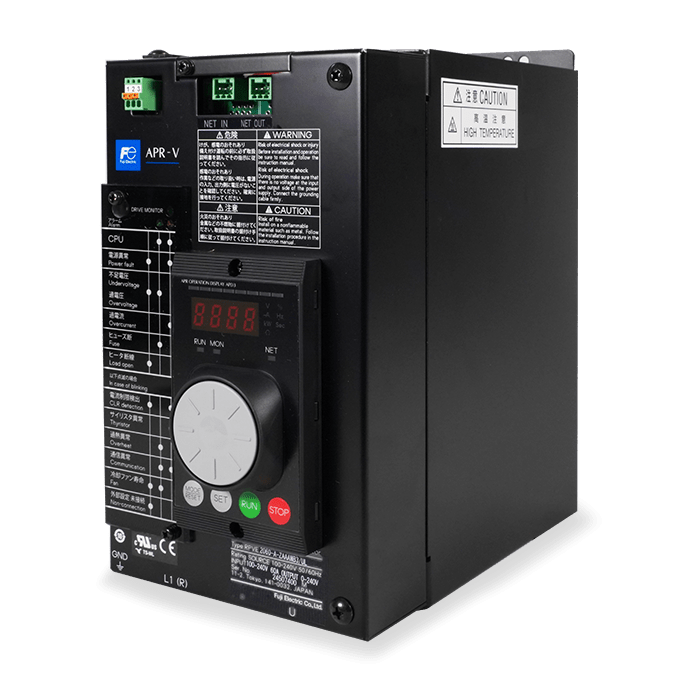
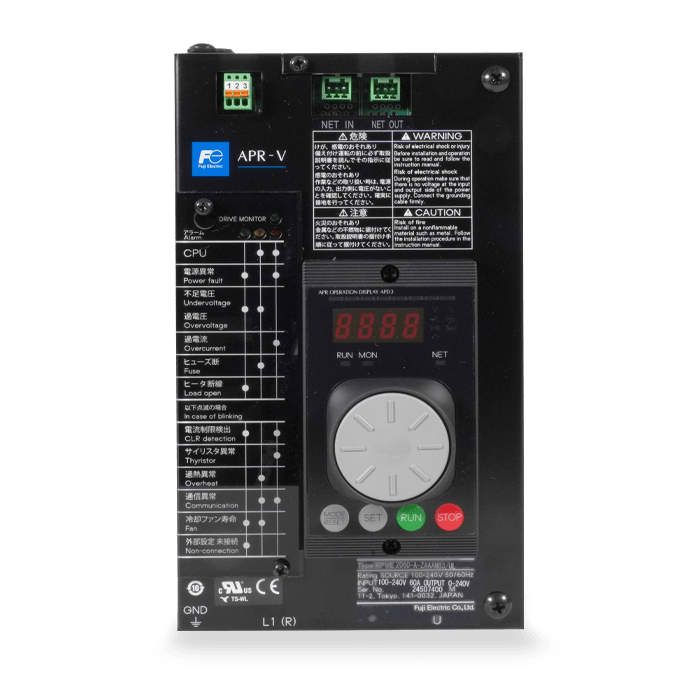
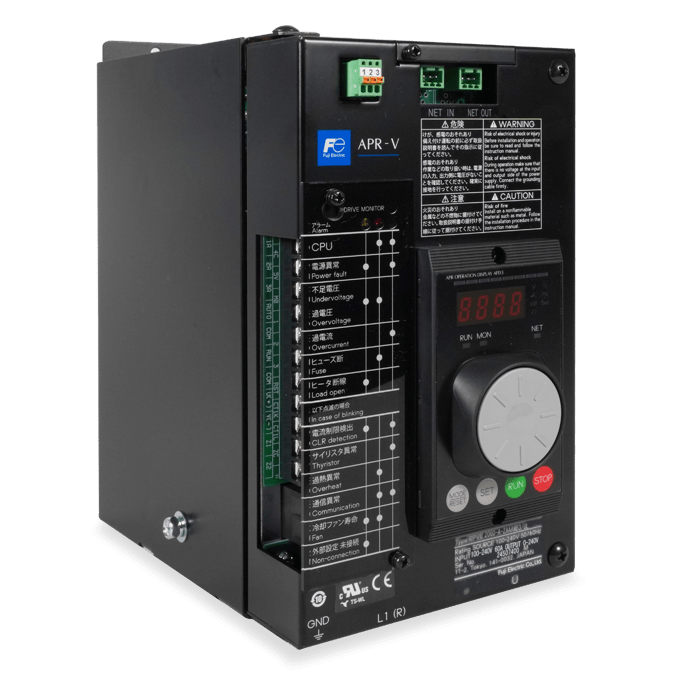
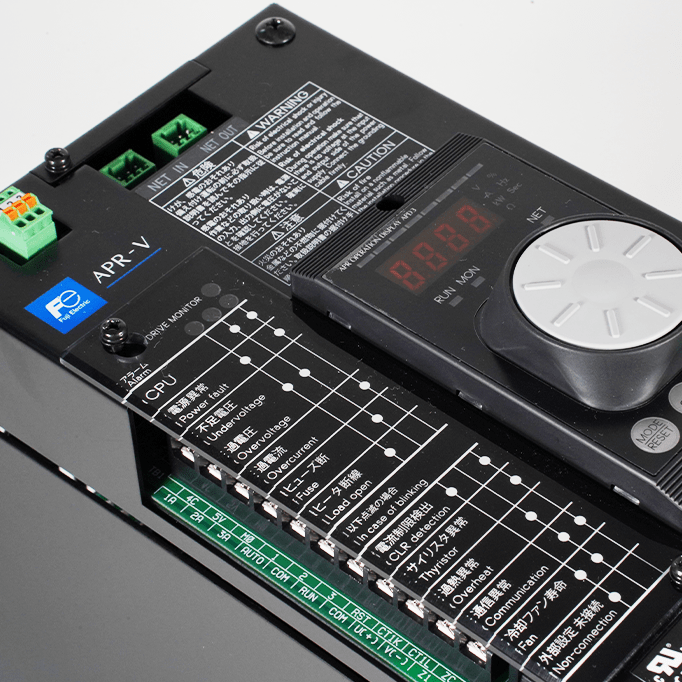
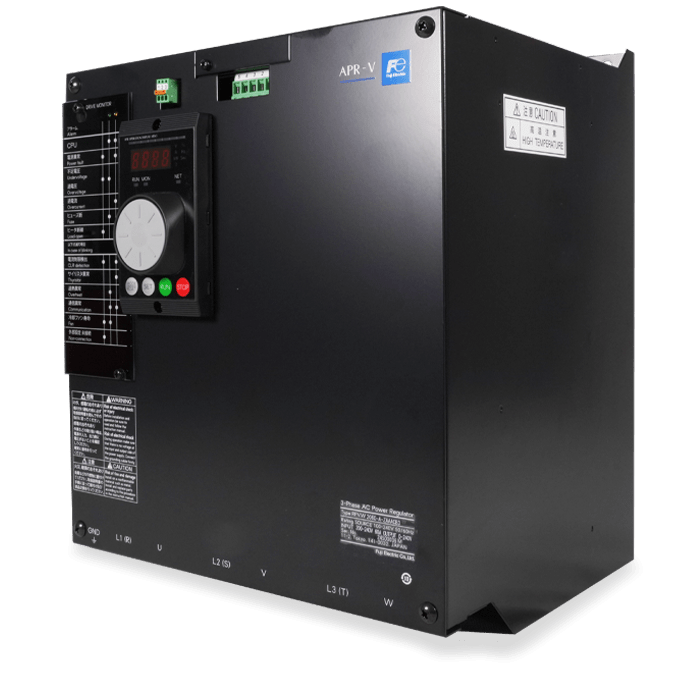
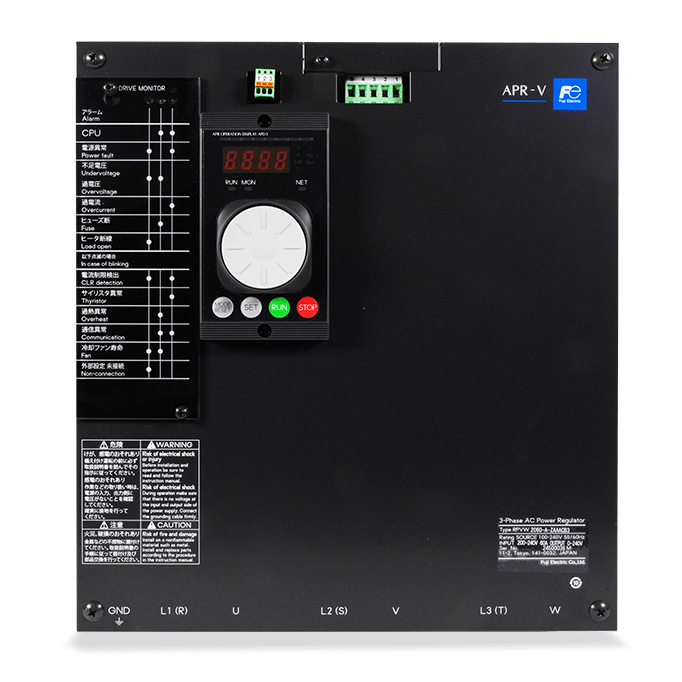
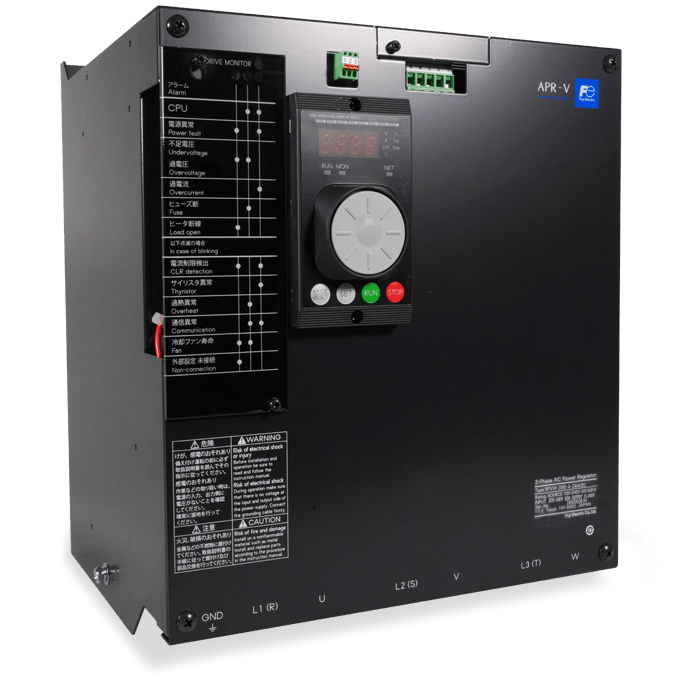
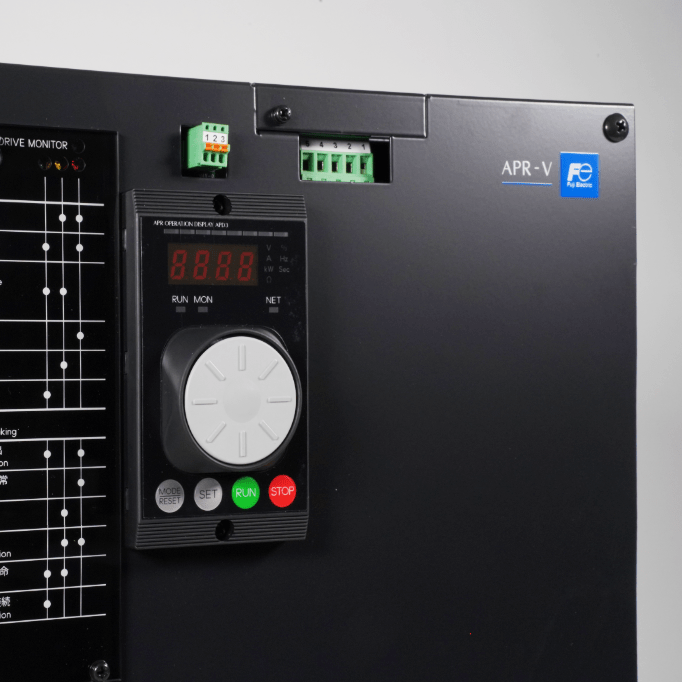






Three-phase power controller with communication features – APR-V
ref: RPVW
Retail price
depending on configuration
Discounts available on request
Request a quoteSingle-phase power control
Fields of application
Single-phase furnace and machine heating, control of variable-resistance heating elements, primary-side control of transformers and rectifiers, and compatible lighting dimming.
Benefits
Fuji Electric’s APR-V single-phase power controller adjusts the power supply to industrial equipment based on a manual or automatic setpoint. When paired with a temperature controller, it controls heating while taking the load’s electrical behavior into account. Depending on the version, its feedback functions allow for the regulation of current, voltage, or power. The optional APD3 display facilitates adjustments and allows users to view operating data. Optional communication cards also enable the power controller to be integrated with a PLC or a supervisory interface.
| Rated current [A] (Ambient temperature 50 °C) | 20, 45, 60, 100, 150, 250, 350, 450, 600 | |
| Main circuit power supply | Supply voltage | Single-phase 100 to 240 V AC, 380 to 480 V AC ±10% |
| Frequency | 50/60 ±2.5 Hz (automatic frequency detection and switching) | |
| Control circuit power supply | Supply voltage | 100 to 240 V AC ±10% (However, only sinusoidal operation is guaranteed. Must operate in phase with the main circuit power supply.) |
| Frequency | 50/60 ±2.5 Hz (automatic frequency detection and switching) | |
| Power supply capacity [VA] | 36 | |
| Applicable load | Phase control | Resistive load, inductive load, transformer primary side, rectifier primary side |
| Cycle control | Resistive load, inductive load, transformer primary side | |
| Control type | Waveform control method Output voltage adjustment range I/O characteristics Supply voltage compensation (Applicable to models with T and A control methods) Adjustment signal (manual or automatic adjustment) Gradient setting Base load setting Soft start and soft rise/fall times Feedback control (phase control method only) Automatic inrush current suppression (cycle control system only) | |
| Error detection and protection | CPU memory error Power supply fault Undervoltage Overvoltage Overcurrent Rapid fuse blowout Heating element burnout Current limit detection Thyristor error Overtemperature error Communication error (optional) Cooling fan life (fan-cooled models only) External control input not connected Load error (models with P control method only) Analog output current error (optional) Alarm contact output | |
| Ambient temperature | -5 to 50°C (lower than rated current at ambient temperatures between 50 and 55°C) | |
| Storage temperature | -20 ~+60℃ | |
| Ambient humidity | 30-90%RH (non-condensing) | |
| Environment | Protected from corrosive gases, dust and vibration. Indoor use. Altitude up to 1000 m. | |
| Withstand voltage (main circuit to ground) | 2000 V AC for 1 minute (100 to 240 V), 2500 V AC for 1 minute (380 to 480 V) | |
| Insulation resistance (to earth) | 10 MΩ min. (500 V DC megohmmeter) | |
Its cold resistance and inrush current must be taken into account. The APR-V power controller is available in versions with current limiting or power control, suitable for different heating behaviors. The selection depends on the material and the process.
Current regulation affects the output current, voltage regulation affects the output voltage, and power regulation affects the electrical power supplied. Our article explains the feedback principles of SCR power controllers.
Yes, with the appropriate configuration. Primary control via pulse trains specifically requires the P version and compliance with its terms of use. Compatibility should therefore not be determined based solely on the electrical rating.
No. Modbus RTU communication requires the ZAM option; CC-Link uses the ZAC option. You must also have the APD3 to configure the settings related to these options.
The APR-V power controller regulates the power supply to the load. The PID controller calculates the heating demand based on the measured temperature and the setpoint. Learn how they work together in our guide to how a PID control loop works.
Retail price
depending on configuration
Discounts available on request
Request a quote
Retail price
depending on configuration
Discounts available on request
Request a quote
Retail price
depending on configuration
Discounts available on request
Request a quoteSingle-phase power controller with communication features – APR-V
Reference : RPVE