The CEE data sheet IND-UT-134 v.A35.2 concerns the implementation, in industry, of a system for measuring Energy Performance Indicators (EPI) designed to monitor the energy performance of one or more pieces of equipment that constitute an energy-using application.
To comply with the specification, the system must, among other things, be capable of measuring, recording, and storing data; calculating and communicating the re EPI to the user; and alerting the user in the event of a deviation.
Last regulatory review: September 2026.
To understand how the program works in general, the roles of beneficiaries and obligated parties, and the main steps involved in a transaction, please see our guide to Energy Savings Certificates for businesses.

Form IND-UT-134 is one of the standardized procedures under the Energy Savings Certificates program.
It enables—subject to compliance with regulatory requirements—the implementation of a measurement system designed to track Energy Performance Indicators in industry.
For the general rules governing the CEE program, see our dedicated guide.
The Energy Performance Indicators measurement system (EPI) is a set of equipment, data acquisition tools, and software used to measure and monitor the energy performance of industrial applications.
It allows you to track energy consumption,identify opportunities for improvement, and implement strategies to reduce energy consumption and associated costs, while helping to protect the environment.


The standardized CEE data sheet titled “EPI Measurement System” (reference IND-UT-134) is intended to finance the implementation of Energy Performance Indicators (EPI). These indicators apply to one or more pieces of energy-using equipment. The volume of EECs associated with the project may contribute to financing the measurement system, depending on the valuation terms proposed by the relevant EEC provider. This process involves a data collection system and an energy management software solution. Thus, industrial sites can implement a system to measure indicators in order to improve their energy performance. The measurement system may include existing components and be supplemented with new ones. Possible measurement components include: compressed air meters, steam meters, water meters, condensate meters, thermal energy meters, electricity meters, gas meters, pressure gauges, flow meters, temperature sensors, heat transfer fluid meters, communication gateways, data logging systems, and energy management software.

Form IND-UT-134 applies to equipment or groups of equipment that constitute one of the following energy uses:
*For industrial machines operating intermittently, reducing compressed air consumption may also fall under EEC sheet IND-UT-140, which addresses automatic standby mode for machines that use compressed air.


Communicate

Alert

Measure

To be eligible for EEC form IND-UT-134, the rated power of the equipment or set of equipment constituting the energy use being measured must be 10 MW or less.
When the measurement system covers a set of devices, the rated power to be used is the sum of the rated powers of the devices being measured.
The metering system must be capable of measuring, recording, and storing the data necessary to calculate Energy Performance Indicators (EPI). The system must be capable of measuring and collecting the parameters necessary to calculate EPI at intervals of 10 minutes or less.
For the “industrial thermal or electrical process” use case, certain production data may be collected at intervals longer than 10 minutes, provided that the interval remains less than or equal to one day, in accordance with the conditions set forth in the data sheet.
For thermodynamic equipment, the power to be considered is the rated electrical power.
The measurement operating system must, at a minimum, allow for:
Energy management software may be purchased, leased, or subscribed to, and must enable the establishment and monitoring of the “ EPI ” in accordance with the requirements of the fact sheet.
Traditional office software such as spreadsheets (e.g., Excel) are not considered energy management software as defined in the IND-UT-134 fact sheet.
| Industrial process, thermal or electrical | Efficiency (kWh/production unit) |
| Heat production and/or distribution | Specific heating efficiency (%) |
| Compressed air production and/or distribution | Specific energy consumption (Wh/Nm3) |
| Cold production and/or distribution | COP (kWh refrigeration/kWh electricity) |
| Other motorized systems (Motorized systems other than cooling and compressed air production (pumps, grinders, fans, conveyors, etc.). | Yield (%) |
The installation of the measurement system must be preceded by a preliminary study conducted by a professional or an engineering firm. This study must, at a minimum, cover the steps specified in the measurement and monitoring plan defined in the NF EN 17267 standard.
Note:
Backup equipment is excluded from the metering system eligible under IND-UT-134.
The same piece of equipment cannot be the subject of multiple CEE applications under IND-UT-134, except in the case described in the fact sheet where it uses multiple energy sources simultaneously and the power requirements are met.
Simply collecting consumption data from energy suppliers’ meters does not qualify for the IND-UT-134 program.
For compressed air systems, please also refer to the CEE IND-UT-140 technical data sheet on automatic standby mode for machines that use compressed air.
For projects involving the electrification of industrial heat generation, please also refer to CEE IND-UT-141, the information sheet on industrial electric boilers.
For induction motors equipped with an electronic speed control system, see also the CEE IND-UT-102 data sheet on speed control.

To make the process easier for you, Fuji Electric’s engineers and technicians will assist you in developing and implementing your measurement plan. The Fuji Electric teams can help with defining the measurement plan, selecting instrumentation, acquiring data, commissioning the system, and performing metrological monitoring.

Determine

Calculate

Define

Thanks to its recognized expertise in the field of energy efficiency, Fuji Electric can help you implement your Energy Performance Indicator measurement system project. We appoint a single point of contact to monitor and manage your project.

Our energy metering solutions are designed to benefit you on a strategic, global and operational level. They give you easy access to all your plant's energy information in real time.
This enables you to identify sources of optimization and efficiency. So you can better manage your industrial site.
In addition, we offer real-time monitoring of energy performance indicators. Our monitoring solution can be integrated into a metering system that meets the requirements of technical specification IND-UT-134, provided that the entire system and operation comply with the conditions set forth in the specification. This monitoring of measurements ensures daily energy tracking for your industrial operations.
Finally, these energy indicators are designed to help you make the most appropriate strategic decisions. So you can optimize your energy performance.
Our counting solutions facilitate the acquisition, recording, communication, understanding and exchange of information via interfaces tailored to your needs.
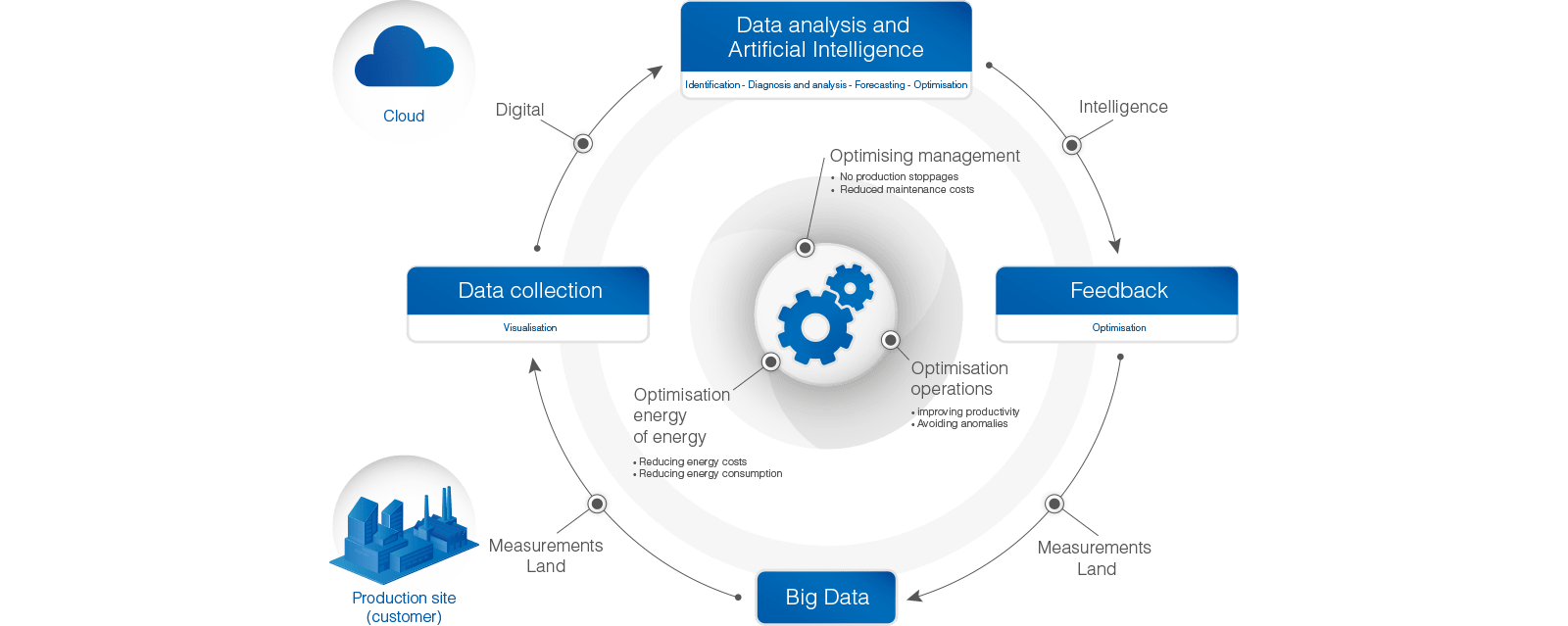

Thanks to our communication systems, energy values, fluid and electrical metering and all your measurements can be accessed locally for daily monitoring by your operators.
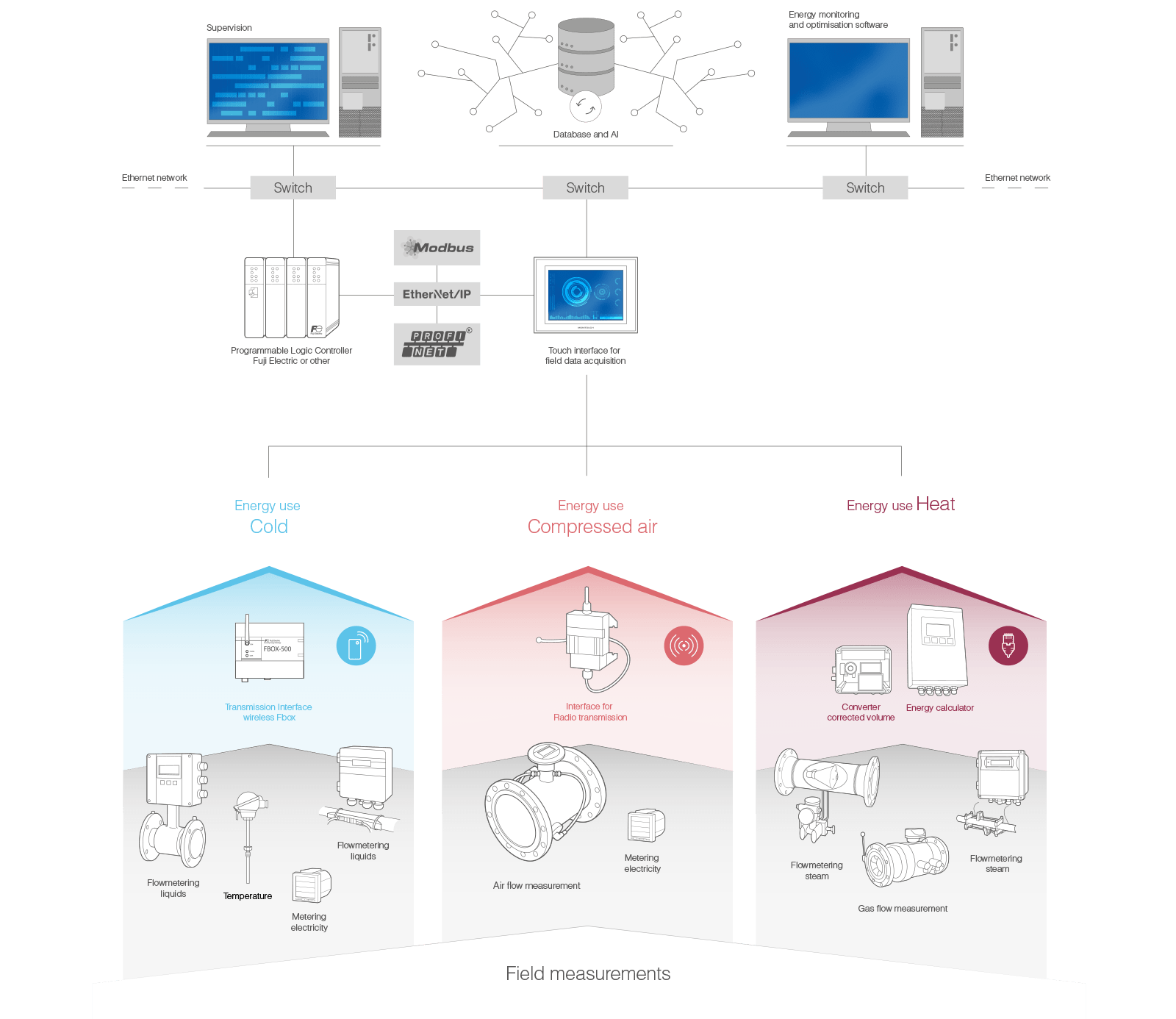
Monitouch's dedicatedHuman Machine Interface enables real-time visualization of measurements and data storage, andinterfaces with existing automation systems, your supervision systems or our energy monitoring and optimization software. The Energy Performance Indices of your installations are shared in the form of a database.
So you can make the best decisions to optimize your energy performance.
An IND-UT-134 measurement system can combine several functional modules depending on the specific energy use being monitored.
Meters and sensors are used to measure energy consumption and the parameters needed to calculate EPI : electricity, flow rate, pressure, temperature, compressed air, steam, or thermal energy.
Controllers, gateways, and data acquisition systems collect data from various instruments and transmit it to the energy management system.
A user interface or monitoring system allows operators to view measurements, re EPI , and related alarms.
The energy management software tracks historical data, calculates metrics, compares them to benchmarks, and detects deviations.
Last regulatory review: September 2026
Since the terms of the CEE program are subject to change, it is important to verify which version of the fact sheet applies on the date the transaction begins.

CEE IND-UT-134 specifies the implementation, in industrial settings, of a system for measuringEnergy Performance Indicators (EPI). The system must be capable of measuring and collecting the data necessary to calculate the EPI, storing the information, communicating the results to the user, and alerting the user in the event of deviations.
IND-UT-134 may apply, in particular, to the production and distribution of heat, the production and distribution of compressed air, the production and distribution of cooling, certain thermal or electrical industrial processes, as well as other motorized systems that meet the conditions specified in the data sheet.
The rated power of the equipment or the entire set of instrumented equipment must be 10 MW or less.
When a measurement system involves multiple pieces of equipment, the power used is the sum of their rated powers. For thermodynamic equipment, the power used is the rated electrical power.
The system must generally be capable of collecting the data needed to calculate the EPI s at intervals of 10 minutes or less.
For certain production parameters associated with a thermal or electrical industrial process, the data sheet specifies special conditions that allow for a data collection interval of up to one day.
Yes. The installation of the measurement system must be preceded by a preliminary study conducted by a professional or an engineering firm.
This study covers, at a minimum, the steps specified in the measurement and monitoring plan defined in the NF EN 17267 standard.
No. Traditional office applications such as spreadsheets(e.g., Excel) are not considered energy management software that meets the requirements of IND-UT-134.
The software must provide the functions necessary for monitoring EPI, including data analysis, data archiving, and the detection of deviations.
No. The software may be purchased, leased, or subscribed to, provided that the functions and conditions set forth in IND-UT-134 are met.
No. Emergency equipment is excluded from the measurement system eligible under form IND-UT-134.
Depending on the installation, a measurement system may include energy meters, flow meters, pressure transmitters , and temperature sensors, PLCs or data acquisition systems, an HMI or monitoring system, and energy management software.
Eligibility, however, does not apply to an individual instrument, but rather to the entire measurement system and its compliance with the conditions specified in form IND-UT-134.

The performance of a measurement system also depends on the reliability of the instruments used.
Fuji Electric offers calibration, verification, maintenance, and metrological monitoring services to ensure the quality of the measurements needed to track your Energy Performance Indicators.

Eric STOECKEL
Energy efficiency application engineer