





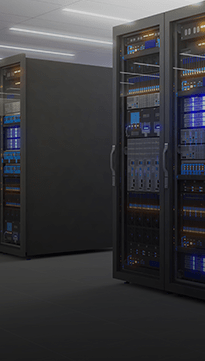


Data center cooling involves continuously removing the heat generated by servers, network racks, and storage systems to ensure safe and stable operation, using chilled water loops, direct liquid cooling (DLC), and, increasingly, precise flow control.
With the exponential growth of data centers—driven by the cloud, artificial intelligence (AI), and big data—increasing power densities make this challenge even more critical for data center operators, managers, cooling engineers, energy efficiency managers, and IT infrastructure experts.
Ultrasonic flow meters are now establishing themselves as a reliable, non-intrusive measurement solution for optimizing data center cooling systems, whether they use chilled water, direct liquid cooling (DLC), or are based on more advanced architectures.
When cooling can account for up to 40% of a facility’s electricity consumption, better measurement and control of flow rates can directly improve energy efficiency, reduce operating costs, enhance equipment availability, streamline maintenance, and lower the environmental footprint.
The primary role of a data center cooling system is to extract the heat generated by IT equipment (servers, network racks, storage) in order to maintain safe and stable operating conditions. The principle is simple: every kilowatt consumed by IT is converted almost entirely into heat, which must be continuously removed.
This article examines the main cooling technologies—chilled water, direct liquid cooling, and immersion cooling—as well as the importance of monitoring fluid flow rates to improve the efficiency, sustainability, and overall operation of the infrastructure.

To improve performance, many data centers use chilled water systems. Heat is transferred from the air to the water via heat exchangers and then removed through:
These hydraulic architectures enable better thermal control, improved energy efficiency, and optimized large-scale cooling distribution.


With the rise of AI, high-performance computing (HPC), and high-density racks, liquid cooling is becoming essential. Two main approaches coexist:
In these architectures, controlling fluid flow rates is essential to ensure consistent thermal performance and equipment safety.

The figures illustrate the extent to which cooling is an energy, economic, and environmental issue for modern data centers.
These figures clearly show that the performance of a data center no longer depends solely on servers, but also on measurement accuracy, throughput control, and cooling system optimization.

A modern data center converts almost all of the electrical energy it consumes into waste heat. However, data centers must balance very dense workloads with sustainability goals.
Cooling systems must therefore:
Under this regulatory framework in France and across Europe, energy audits are mandatory for facilities consuming more than 2.75 GWh. Waste heat recovery is required for sites with a capacity of at least 1 MW, and the 2026 law strengthens energy reporting requirements for data centers.
In this context, accurate and continuous flow measurement is essential for the effective operation of the systems, and the selection of cooling fluids must also take PFAS regulations into account.

Ultrasonic flow meters have many applications in data centers, wherever control of hydraulic flows is essential to the performance, safety, and energy efficiency of facilities.

In chilled water cooling systems, ultrasonic flow meters are used to:
They ensure even distribution of cold air and prevent energy waste caused by excessive flow rates.

Check

Monitor

Check

With the development of liquid cooling systems, measurement accuracy is essential, and this type of architecture can reduce the PUE to as low as 1.02 in the most efficient cases.
Ultrasonic flow meters are used for:

Cooling units serve as the interface between the IT cooling loops and the building's hydraulic systems, ensuring seamless integration withthe existinginfrastructure.
Ultrasonic flow meters play a key role in:
This measure also helps anticipate integration issues between CDU, existing networks, and new loads.

By providing reliable, continuous data, ultrasonic flow meters directly contribute to monitoring the Power Usage Effectiveness of data centers and to:
These results also highlight the benefits of cost optimization: with immersion cooling, the PUE can drop to 1.02, a 1-MW data center can save several hundred thousand euros per year, and the average return on investment can be 2.2 years.

Integrated into energy management systems, ultrasonic flow meters enable:
This data also makes it easier to detect readingerrors, flow rate deviations, or billing anomalies related to the monitoring of meters and measurement points before they affect operations.
Thanks to their versatility, ultrasonic flow meters are becoming key instruments in supporting the evolution of data centers toward more efficient, energy-efficient, and resilient infrastructures .

Ultrasonic flow meters have features that are particularly well suited to the constraints of data center cooling systems, where reliability, accuracy, and continuity of service are key requirements.
Their main advantages for cooling data centers are as follows:
This level of measurement accuracy also helps to objectively assess the potential cost savings over the product's life cycle, including when compared to immersive architectures.
Thanks to these advantages, ultrasonic flow meters are a key tool for ensuring the safety of cooling systems and sustainably improving the energy efficiency of data centers.


Non-intrusive measurement

Reduced maintenance

Measurement accuracy

Compatibility

High reliability

Flow measurement ensures that the amount of coolant circulating in the hydraulic loops is appropriate for the actual IT load. Accurate measurement prevents the risk of overheating, limits overcooling, and directly contributes to energy optimization and PUE reduction.
Ultrasonic flow meters are non-intrusive, have no moving parts, and cause no pressure loss. They offer excellent reliability, require little maintenance, and are particularly well suited to data center infrastructure, where service continuity is essential.
Yes. Ultrasonic flow meters are perfectly suited to direct liquid cooling (DLC) circuits, particularly for controlling the flow rates feeding the cold plates of CPU and GPU processors, as well as for controlling CDUs.
Yes. Thanks to their non-intrusive technology, ultrasonic flow meters can be installed on existing networks, including large-diameter pipes, without major service interruptions or extensive modifications to the installations.
By providing reliable, real-time flow data, ultrasonic flow meters optimize pump operation, balance hydraulic circuits, and reduce energy consumption related to cooling.
Cooling systems play a decisive role in the environmental impact of data centers. A significant portion of the energy consumed is related to cooling and thermal management of the facilities. Liquid cooling and free cooling solutions, when properly designed and implemented, can significantly reduce overall energy consumption.
The energy efficiency of a data center is generally assessed using PUE (Power Usage Effectiveness), which measures the ratio between total energy consumed and energy dedicated to IT and cooling equipment. Inadequate thermal management can significantly degrade this ratio, leading to overconsumption of energy, increased water demand, and major repercussions on the reliability of equipment and infrastructure.
Improving environmental performance requires more energy-efficient cooling solutions, better control of temperatures, flow rates, and resources, as well as the adoption of methods, tools, and innovations adapted to the constraints of data centers. These elements are essential for supporting corporate decision-making and designing more sustainable infrastructures with better indicators such as PUE and CUE.

Aurélien BARRA
Technical Manager - Flow measurement and flowmetering systems